
About us
Welcome to DMT Industrial Maintenance
At DMT Industrial Maintenance, we provide professional on-site Heat Treatment and Welding services for critical components in demanding industrial environments.Our team of experienced technicians and welders delivers precision, reliability, and safety directly at your facility, helping you reduce downtime and ensure that your welded structures, pipelines, and heavy equipment meet the highest standards of performance and durability.Whether it’s post weld heat treatment (PWHT), PreHeating, Annealing, Normalizing, Hardening, Tempering, Hydrogen Bake-Out, Furnaces or local Heat Treatment, DMT Industrial Maintenance is committed to excellence in every project we undertake.
Services:
Heat Treatment
PWHT: Relieves internal stress.
Welding creates uneven heating and cooling → this locks stress inside the metal.
PWHT reduces that stress so the part doesn’t deform or crack later.
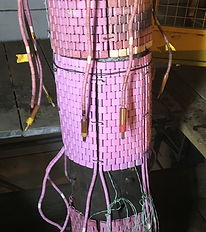
PreHeating: Prevents cracking.
Before starting the weld, we raise the temperature of the metal (for example to 100–300°C depending on the material). This helps control how the metal behaves during welding, imprives welding quality and reduce moisture (Hydrogen) on the weld.

Annealing: Softening.
Annealing is a heat treatment process used mostly to increase the ductility and reduce the hardness of a material. This change in hardness and ductility is a result of the reduction of dislocations in the crystal structure of the material being annealed.

Normalizing: Refines grain structure.
Normalizing is a heat treatment process that restores a metal's uniformity, ductility, and toughness. It involves heating the metal above its critical recrystallization temperature and then letting it cool in still air at room temperature.
Hardening: Improves strenght and weariness.
Hardening is a metalworking process that increases a metal's hardness, strength, and wear resistance by heating it to a specific high temperature and then rapidly cooling (quenching) it.

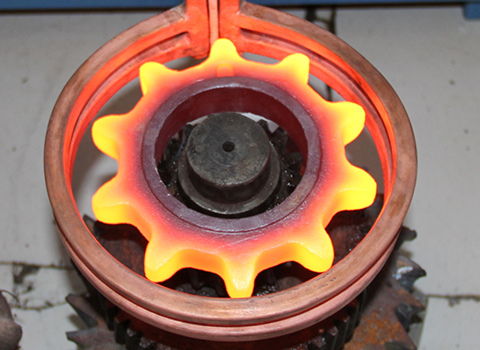
Tempering: Less brittle and more usable.
Tempering is a heat treatment process that reduces the brittleness of hardened metal by reheating it to a specific temperature below its critical point. While hardening (quenching) makes metal extremely hard, it also makes it prone to cracking; tempering trades a small amount of that hardness for significantly increased toughness, ductility, and stress relief.

Hydrogen Release: Prevents hydrogen cracking.
Hydrogen bake-out is a heat treatment process that removes dissolved hydrogen from metal to prevent hydrogen embrittlement and cracking. By heating the metal (typically to 200°C–315°C) for several hours, hydrogen atoms are forced to diffuse out of the material’s crystalline structure.
Induction: Rapid Heating with precision.
Induction heating is used for metal parts primarily because it offers fast, precise, and energy-efficient heating without direct contact or open flames. By using electromagnetic fields to generate heat directly within the metal (via eddy currents), it allows for highly localized, repeatable, and cleaner processing compared to traditional oven or torch methods.
Furnaces: Precise Temperature Control, Time & Cost Efficiency.
Furnaces are used in metalworking to heat metals to precise temperatures for processes like annealing, normalizing, hardening, tempering. They give control, safety, uniformity and can heat several parts at once.
Welding:Welding services involve the joining of metal parts using heat, pressure, or both to create strong and durable bonds.
Common processes such as MIG, TIG, and arc welding (SMAW) are used to fabricate, repair, and maintain structures and equipment. These services are essential in industries like construction, Shiprepair, and manufacturing, ensuring safety, precision, and long-lasting results. Professional welding services can be tailored to different materials and project requirements, delivering high-quality workmanship for both small and large-scale jobs.


Pipe Demagnetizing:
is the process of removing unwanted magnetic fields from metal pipes, usually after cutting, welding, or handling with magnetic tools. Excess magnetism can interfere with welding quality by causing arc blow and defects. Using specialized equipment, the magnetic field is neutralized to ensure smooth welding, improved safety, and better overall performance of the pipe.
